Recent Comments

Popular Posts

Showing posts with label FIVE. Show all posts

FIVE: Lalah Hathaway

Written By UNDER MAINTENANCE on Saturday, November 5, 2011 | 3:55 AM

“FIVE” is a special feature at BlackArtistNews where five questions are posed to an individual artist, curator, gallerist, collector or art lover. Why five questions? Well, there are five fingers on each hand and artists create with their hands hence one, two, three, four, FIVE.
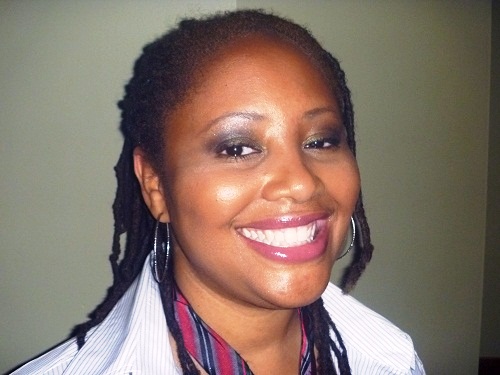
Lalah Hathaway. BlackArtistNews photo. All rights reserved.


The cover of Lalah Hathaway’s recording Where It All Begins is a visual concept that sings. Artist Chris Herod pays homage to the singer’s musical roots by cleverly twisting her locks into a well-tuned narrative of her genetic (she’s the daughter of soul music legend Donny Hathaway) and artistic makeup. It’s an ingenious arrangement of form and content that’s psychologically hip and aesthetically engaging. The same can be said about the music contained on the CD. The GRAMMY winner eagerly spoke with BlackArtistNews about the visuals for Where It All Begins on two occasions: in early October at the Dakota nightclub in Minneapolis, MN and two weeks later via phone. Of course we talked music: Jimi Hendrix was a brief topic (Hathaway loves his music and is contemplating one of his songs for her live show), her appearance with the Roots on the Jimmy Fallon Show (the host didn’t plug Where It All Begins), and pianist Robert Glasper, who she collaborated with to record Sade’s “Cherish the Day” for his soon-to-be-released recording (“It’s killer, if I do say so myself,” she confided.) But the framework of the conversation was visual art and the mellifluous “First Daughter of Soul” sang in high praise of it in “FIVE”:

First of all, I think the album art for Where It All Begins is smart and clever and inspired.

Thank you.

To me, it’s really not surprising that you use an illustration for the cover because with the exception of one of your dad’s albums all of them were graphic depictions rather than photographic images.

Right.

So what factors weighted into your decision to go with an illustration?

Well, I… You know I love art. You know I love art.

I know you do.

I met a guy on my web site named Chris Herod who created these beautiful things and brought them to a show in Dallas. He makes these etchings on vinyl. And they look crazy. It’s like only a crazy person could really figure out that they can use an X-ACTO® knife and create a person, a human being on a record. It was just crazy. And [from there] he started creating stuff and came up with [something] and I said I want to use [that] as a cover… we developed that idea. I wanted to use a beautiful piece of art. I feel like people don’t get a chance to look at beautiful things a lot. And part of it also was I was so trying to um... well, what I really wanted to do was present myself as an artist, which I feel like I always do. Even though people said it’s gonna be shrunken down to the size of a postage stamp or blah, blah, blah, blah, blah… I just wanted it to be beautiful. I was trying to get them to issue it on vinyl because it’s really great like that.
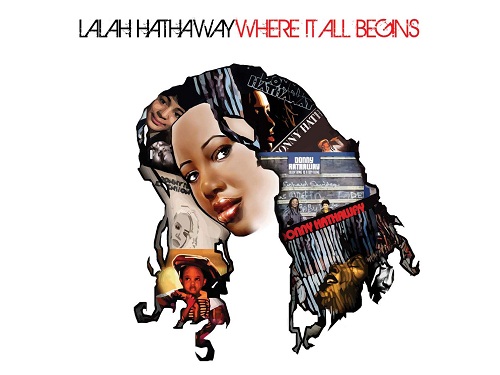
Order a signed limited-edition poster of Where It All Begins here


You told a reporter for IndyStar.com that initially you thought the idea of superimposing your image into your dad’s album covers was a “presumptuous and creepy” idea.

I thought it was a creepy idea. Well, the thing was I wanted to use daddy’s covers and they, uh, they didn’t know who the artists [or] photographers were, and so that was a licensing issue and then someone said ‘Oh, why don’t you put yourself in it’ and so, um, it wasn’t the cover I thought was creepy, it was something else I saw and thought was a little bit creepy. But the cover I thought isn’t too presumptuous. I’m totally comfortable with it.

I don’t get why you would call it ‘creepy’ because the concept is not that different from the T-shirt you sell at your concerts you know the one that’s half your face and half your dad’s face. To me it’s the same concept just executed differently.

Well, they’re both a little creepy and when I say ‘creepy’ I don’t mean creepy as in ‘creepy crawly’. I mean creepy as in ‘wow’. You know, mind-blowing. 

Is that your mom right above your forehead in the image?

Yeah.

Right before your second set in Minneapolis I hung out with her at your merchandise table and I was happy to see that you still have those Son of Ellis T-shirts, you even signed a couple of them when we were talking in your dressing room. I own one of those shirts. I love it.

Yeah, you know I actually have a few of those left and those are the last ones. After that, it’s a wrap on that. I [won’t] have any more.

So they’re collector’s items.

They are.
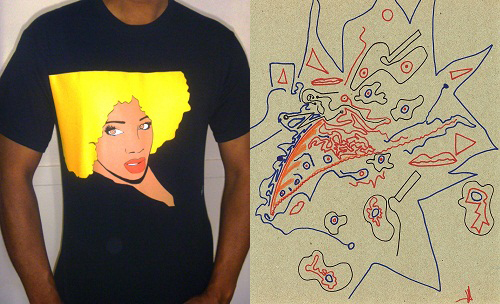
Left: Lalah Hathaway T-shirt by Son of Ellis. Right: Untitled line drawing by Lalah Hathaway (2004).

I noticed you have one of his illustrations on your web site, but you have art on there by other artists as well.

Yeah, I think I get a lot of fan interpretation art which is so cool, I really love that.

Do fans give you art?

They really do. I have gotten some of my most valued [and] treasured things from [them.] Chris Herod gave me stuff before he did the cover and I get a lot of just art period. It makes me happy when someone is moved to be creative. That makes me very happy.

Did you take any art classes in high school? You attended a performing arts high school, right?

I did. I think I took the very basic ‘all-the-musicians-had-to-take-art’ art class. [Someday, I will] just probably end up taking [a] fine art class. It’s something I’m really interested in and I think that eventually… I have such a passion for art and just being creative that I’d like to find some other outlet. I’d like to try some sort of art or design class where you make stuff, you know what I mean? I don’t even know what it would be.

You were making jewelry at one point…

Yeah, I still do jewelry. I’m crocheting. [Well,] I’m going to start crocheting again. I have a friend who sculpts and that seems like the [craziest]… I don’t even understand how you figure out you can do that. It’s incredible.

Do you know whether or not your father drew pictures or liked art?

That’s a good question. I don’t know. That’s a question I would ask my mother. I have no idea.

I like your new promo photos by Derek Blanks.

Thank you.

I know he’s primarily a fashion and portrait photographer but he’s also known for his Alter Ego series of photographs. Did you do anything like that with him?

I did. I did one where I was a ventriloquist and a dummy.

[Laughs] I LOVE it!

You never saw that?

NOOOOOO!!!!

I will send that to you. He actually chose that [scenario] for me. And, um… I thought it was really cute. [Derek] has a real knack for that. He’s really polished that thing. Like that is absolutely his thing and he takes really great, great photographs. He just really knows how to light you and make you look spectacular. That he is number one at for sure.

Lalah Hathaway from the Alter Ego series by Derek Blanks. © Derek Blanks.


So did he play music while you were shooting?

I played music… and then Rahsaan played…

What did you play?

I played everything. I played some Chaka [Khan], I played some Rahsaan [Patterson], I played some Kiki Sheard, some Chicago, some Boney [James], some Miles [Davis] and Herbie [Hancock] and then Rahsaan came and set up his music so, um, we had everything.

Rahsaan Patterson was at your shoot? Where’d the shoot take place?

I did it in L.A. and Rahsaan was at my shoot. And Rahsaan took a whole bunch of photographs and footage and made this beautiful video for me for “Dreamland” (a track on Where It All Begins) and I’m going to put that out.

Hey, speaking of video, who is that guy sketching in your Electronic Press Kit (EPK) for Where It All Begins?

That guy is Jonathan Clark and he is crazy. He’s the guy that initially designed my logo for me. He also makes these incredible drawings on his iPhone with his fingers. He’s an artist. He used to be an exec at Motown. He’s just one of those guys who just does a lot of things but in his heart he’s an artist. So, yeah, that’s Jonathan Clark.

Jonathan Clark. Yeah, tell him I got my eye on that sketch…

He does that everywhere too. He will just sit down at a meeting and pull out his pad and pencil and be going for it, you know.


Lalah Hathaway iPhone drawing by Jonathan Clark. © 2011 Jonathan Clark.


Wow. I think that’s really cool. I love it when I see people pull out a sketch book in public spaces like the bus or train and just start drawing. So, um, does art matter?

Does art matter? What do you mean?

Does art matter?

Absolutely. One hundred percent. It’s one of those questions that when you ask somebody that really knows, it’s like ‘whut?’ but I totally understand it’s a question that has to be asked because so many people don’t understand how much it matters. [To me] art and music are synonymous and all of that stuff matters and is vital. And a society that doesn’t have it is barbaric. That’s how I feel.

Okay, repeat that for me. I didn’t hear you.

A society that does not have it is barbaric.

Gotcha! Heard you loud and clear.

Yeah, absolutely you got to have art. You can see it when you travel as a lot of [musicians] do. But in other places the art is a given. You know what I mean? It’s a given that you’re going to learn some sort of instrument because not only will it make you a happier kid, it will make you better at math and science and reading too, you know? So, yeah, art is essential and a necessary part of life. Absolutely.

3:55 AM | 0 comments | Read More

FIVE: James V. Allen

Written By UNDER MAINTENANCE on Friday, October 7, 2011 | 12:03 AM

“FIVE” is a special feature at BlackArtistNews where five questions are posed to an individual artist, curator, gallerist, collector or art lover. Why five questions? Well, there are five fingers on each hand and artists create with their hands hence one, two, three, four, FIVE.
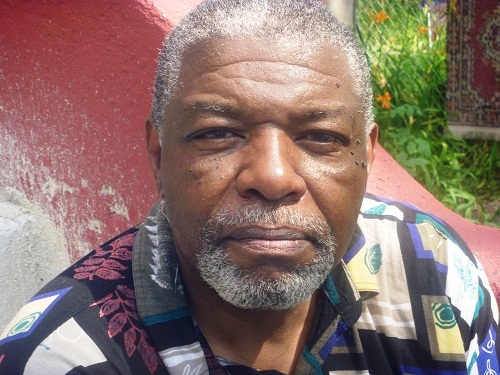
James V. Allen. BlackArtistNews photo. All rights reserved.
In July 2011 the BlackArtistNews RECAP Fear No Art Location chronicled personal events experienced on the way to an opening reception for James V. Allen at a Chicago-based organization called the Urban Art Retreat. The artist kindly agreed to an interview and spoke candidly about his life and practice: he confessed to being emotionally challenged and added that art is a stablizing component that enables him to lead a balanced and productive life. Currently, Allen’s work is included in Chicago Black Artists Art Networks a group exhibit showing Saturdays October 1 – November 12, 2011 at the Urban Art Retreat. If you ever doubted the transformational power of art, you will change your mind after reading this edition of “FIVE”:


Are you from Chicago?

I originally came from Los Angeles, California. Came here ten, almost eleven years ago. I used to come annually to visit my sister. And then she got cancer, breast cancer and ten years ago she passed on. And instead of going home, I stuck around; I wanted to be close to my nephew. I also… I’ve always appreciated that Chicago is very much an art town. And then of course after she died I went into depression. I suffer from bi-polar, manic depression and all that stuff. And I went to a center to get therapy and medicine.

Here in Chicago?

Here in Chicago. It’s over in Lawndale. (Note: Lawndale is a west side neighborhood in Chicago.) That’s where I started painting again. You know along with the therapy and medication I started to come out of the depression. And after about five years I was not only going to the place I was teaching a few art classes.

Where?

At this place called Lawndale Mental Health Center it’s on Campbell and Roosevelt. Recently I’ve been filling in for Dianna [C. Long, Director of Urban Art Retreat] over at this place called the Sacred Heart. I go there on Thursdays and I teach an art class over there. For mentally disturbed people an art class is really just allowing them to come in and do what they want to do. So since I’ve been here at the Urban Art Retreat I’ve been working with Dianna. Last year we did After School Matters [where] we taught [teenagers] how to paint. That was good. Last year she helped me get my first show going.

Where was that?

This was at a restaurant which ceases to exist right now. She’s also helped me with some of the technical aspects of art; teaching me things but of course I’m still like a lot of people in the Art Retreat still suffering from depression. And [being] bi-polar [means] you are either up and/or frustrated or you are down and you just disappear.

When looking at the faces in your work I could tell that they were coming out of some sort of melancholic state.

There you go. I did dark, depressing work while I was in the institution until the director began to object [Laughs] and now I’m feeling a lot better. I’m trying to put more light into it. Of course my subject matter is always going to stay a little serious – it’s all about prison and slavery and a lot of other things.

Did you draw as a kid? 

As a kid I was pretty much struggling with Attention Deficit Disorder during a time when they didn’t even know what it was. So I only got good grades in Art and History [Laughs] everything else I completely failed but I always drew. I used to spent hours on the table – my father was a building contractor and he had these tables where he used to put his plans and I would start I say about three o’clock in the afternoon and the sun would be coming out and I’d still be drawing.

In hindsight, do you think that intense concentration was part of the disorder or do you think it was just because you were passionate?

Part of art for any individual with emotional problems is therapeutic, okay. Just like if you don’t know how to meditate, but you know how to sit down and draw something, you can get the same satisfaction [just like] from meditation. Being able to express yourself that way. So yeah, I was pretty much a lonely kid [and] right about when I was maybe three, four I was molested in Los Angeles so that changed my life completely. I never told anybody what happened but I knew something was wrong with me and it just compounded with everything else. So when I was very young my father, who was sort of a progressive black man, recognized that maybe I needed some help. And I can recall lying to the therapist about everything. I didn’t want him to know what was really wrong with me.

But you eventually told the truth or it came out…

It came out after I was grown, fifty years old and over at the Lawndale place – I tried to kill myself. And I began to go to classes and take medication and I began to see that you can manage – you can’t cure these diseases – but you can manage it. So when I was very young my father took me to [art] exhibits and [I] can recall thinking that this would be a good job for a person to grow old doing. [Laughs] Because physicality always leaves but you can still – even though I have heart problems – I’m pretty much not limited with the art I can create. Next thing I’m going to do is get me some glasses. [Laughs] Who knows what’s going to happen once I can see!

So you create the faces in your work out of your imagination.

That’s all it is. When I came here, I was still working with some photographs. But Dianna she said, you should just work from [your imagination.]

Sounds like she really pushed you. In a good way.

Oh, yeah. It always happens that people like me with those kind of problems need to [be pushed.] That’s why we’re trying to build a retreat. That’s because we want a place… over the years teaching a lot of classes I’ve experienced that people who are extremely disturbed they still are capable of expressing themselves. And many of them… I’ve told many of them that this work… that you can sell this work. If they can teach an elephant to paint then I know that you guys can be out there making money. So we’re trying to make the retreat a place where everybody can come. We’d like to have a gallery for the work, you know what I’m sayin’? And I’d have mine in there too! [Laughs] Because I [really] feel a kinship to these people. So that’s pretty much where we are now. We’re trying to expand the work, expand the place. I’m hoping next year to have a much larger place.

Do you play some sort of administrative role with the Urban Art Retreat?

In the process of coming here and having exhibits here they elected me to the board of directors. That sounds good but that means I have a lot more things to do. [Laughs]

That’s a lot of work! That’s a lot of work! [Laughs]

But it's all good. It’s something good, you know. I think that one of the problems I used to have was the guilt of spending all [my] time being an artist while the world goes to hell. Here’s a place where you can actually make the world a better place. 

Does art matter?

Oh, absolutely, man. If we don’t have something in this world that is totally positive then man is left with being a soldier, a killer of children, an exploiter, okay? And [for] civilization really that’s the most positive thing we have going. Outside of the humanitarian things that do exist unfortunately though this system is so committed to exploitation until the humanitarians cannot solve these problems.

But as a commodity artworks do get exploited too.

Yes, they get exploited too, but I’m just sayin’ from the standpoint of what art is, what it really means to people that enjoy it, and what it could mean to people that don’t understand it.

I understand.

I think that everybody should understand that this is one of the best things that human beings have created. From the beginning of time they were in there with a purpose: imagine a cave person with a torch at night trying to get this image down you know what I’m sayin’?


James V. Allen with his work at the Urban Art Retreat.
Photo via UrbanArtRetreat.com


12:03 AM | 0 comments | Read More

FIVE: Elizabeth Alexander

Written By UNDER MAINTENANCE on Friday, September 16, 2011 | 12:21 AM

“FIVE” is a special feature at BlackArtistNews where five questions are posed to an individual artist, curator, gallerist, collector or art lover. Why five questions? Well, there are five fingers on each hand and artists create with their hands hence one, two, three, four, FIVE. 

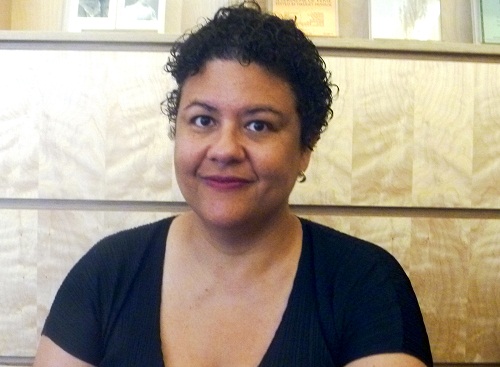
Elizabeth Alexander. BlackArtistNews photo. All rights reserved.
Elizabeth Alexander is a builder of words. She frames them into poetic structures that house memory and metaphor. Few Americans were aware of this before January 20, 2009 the day when the award-winning poet and Yale University professor recited "Praise Song for the Day" at the presidential inauguration for Barack Obama. Alexander is also a devoted art lover; her books are cloaked in works by Henry Ossawa Tanner, Elizabeth Catlett and Romare Bearden, an artist she has applauded in poem and prose. While attending yet another inauguration (the Poetry Foundation's new building dedication event in Chicago) Elizabeth Alexander spoke with BlackArtistNews about the "modernist master" who definitely deserves a high "FIVE":

What was the specific circumstance that lead to your initial writings about Romare Bearden’s work?

I lived with Bearden’s work my whole life. He is a cousin by marriage. My great uncle is the painter Charles Alston, who’s a cousin by marriage to Bearden. And so we had an early Bearden watercolor in the house – a painting in the house –one of the bullfighters. And he was always someone who was in my mother’s stories from her childhood. So that is just to say that I knew there were artists who happened to be African American who were really towering giants to me even if the art historical world and the museum world wasn’t paying the kind of attention to them that they subsequently have come to. 

Then when I was in college I started thinking more analytically and learning more about Bearden’s work. [After] the exhibit that was Memory and Metaphor [in 1991] I started really looking at the collages more. And then studying his work pretty much on my own because again Mary Schmidt Campbell had written her dissertation but there wasn’t a lot of material that was available on Bearden in the early and middle 1980’s. And so his work ended up being the generative source for a theory of collage that I wrote about in my dissertation as a way of thinking about hybrid text by African American women in particular and the process of collage as an African American process of self-making and artistic self-making. 

At that point – again college into graduate school – I corresponded with him a little bit. He was a very generous correspondent; I never met him. But he was open. I just sort of found him I think by calling information and calling him in the studio on Canal Street and he talked to me on the telephone! I told him who I was relative to family but it wasn’t like a family connection: It was an artist responding to a young person who cared about making art and who cared about black culture. 

And so in that period he just became not only my favorite artist but more importantly the artist who taught me the most about making other forms of art. And also someone who I just thought was a dazzling and undervalued genius. So it’s been really gratifying over the last – let’s say twenty years in particular – to see the ways that through the Bearden Foundation and through the museum at the National Gallery and though just the changing times, his work has finally started to get the attention that it should have gotten all along.

Do you think that the general public will ever truly understand why Bearden is an important figure in art history?

Well, you know with the show that was just at Michael Rosenfeld [Romare Bearden (1911-1988): COLLAGE, a Centennial Celebration which ran March 26 - May 21, 2011] that closed about a month ago, the review in the [New York Times] sort of said “finally we see that Bearden was a modernist master” and I had a kind of wry response to that because I thought “well, finally you see.” And I hope that other people will take heed of this: this idea that someone – again, at his centennial – is being discovered as the modernist master that he was is…it’s bittersweet. It’s bittersweet. But you know the art world and its exclusions; it’s a pretty powerfully exclusionary world maybe even more so than the poetry world. So I think things have changed but they need to change more.

You wrote this beautiful, beautiful essay on Romare Bearden for the book Something All Our Own: The Grant Hill Collection of African American Art. How did that come about?

Well again, I had been living with this work and thinking about this work for years and years and years and years and years. And so some of the focused hard thinking in my dissertation came to that essay but I was pleased to be able to write about Bearden in the context of family collecting. And of a young person doing this art collecting and just on a level of responding to the sheer beauty and power of the work; you don’t need to know anything fancy to have that kind of visceral response to it. And that this young man – Grant Hill – who’s someone who I’ve known since he was a child, and to see him taking this kind of really serious interest in art is a wonderful thing.

Was he the individual who asked you the write the essay?

Yes.

Is there a living artist whose work and career interests you?

So many; I follow a lot of artists. One of them would be my husband who’s a painter named Ficre Ghebreyesus. I follow very intimately, I’m sure you know Kerry James Marshall’s work…

Un-huh, [a] local guy. That’s right, you lived in Chicago…

I lived in Chicago, yeah. [Kerry was] a friend from before my Chicago days [and] I think a tremendous modern master. A really, really amazing painter and both my husband and Kerry are really painter’s painters. And they are painters devoted to the art of painting and not to say that both of them…I mean that in Kerry’s work he’s doing with the serials, the comic books and you know he has those installations – I like that stuff – but I feel like he is a painter. And in the same way I think Bearden in the collage form was a painter. That virtuosity I think is really extraordinary. And also I think in all of those artists understanding viscerally and kind of brilliantly the sheer power of color. Understanding it as a life force onto itself – many great artists don’t understand that. And so that’s something that I see in common with a lot of that work. And then – I mean again – there are so many others but I would say that Lorna Simpson is someone else who’s work I have felt in conversation with and engaged with for – she’s my contemporary – she started a little bit before me but not much – and so I feel that all of the intellectual concerns that have gone on in African American literary and cultural studies, she’s been working many of those through in her visual artwork. I think also that her aesthetic is very Zen. Everything is there, they’re lush and generous pictures but they’re also very, very elemental and paired down.  And I think of that in contrast to a Kerry James Marshall aesthetic were there are so many things to look at. There are so many codes to read; there’s so much language. And so to in my husband’s painting there is so much language in them. So part of me loves that, but I feel like in Lorna there’s something very cool water.

What’s your take on her video work?

Fantastic! I mean wonderful! And I think of those kind of in a way separate – I mean I know that they come from one artist but I think of them separate from the still images. And I guess maybe the transitional work would be  – a work I love quite a bit – what’s it called? It’s where all the mouths are singing the [same] song…

I know which one you’re talking about but I don't know the title of it.

"Someone to Love?" It’s a [John] Coltrane song… I really love that because I feel that it as a sort of a piece right in front of you that has its interest but then also as a moving image and something also with sound it’s got another set of interests as well. So I particularly love that piece. (Note: The video's title is “Easy to Remember”. View it here. Listen to John Coltrane's recording of "It's Easy to Remember" here.)

What can creative individuals learn by engaging in dialogue (real or imagined) with artists outside their chosen discipline?

Oh, gosh. Well, I think there always comes a point if you’re a very devoted artist of whatever kind that you bump up against the edges of your material. So in the case of a poet that’s words and that doesn’t mean that they’re not always ways to turn over and approach writing the poem, but I feel that when I’m bumping up against the edges to look across to what a dancer is doing or to what a visual artist is doing or what a musician is doing is just… it sort of torques or turns me toward a different way to approach my own work. And sometimes it’s not even explicit. You know, I can’t trace those steps. But I know that it’s looking outside to people doing things that I don’t know how to do. That can bring me back in with new eyes to the work that I do. Also I think that collaboration is a really exciting possibility too. Again, doing everything that in my case I can do with words and then giving it to the painter, giving it to the musician, giving it to the dancer, giving it to the theater artist and say “Okay, now what do you do?” that’s just cool. [Laughs]

Does art matter?

Oh, my goodness we’re dead without it! Really, our souls are. And does that mean the same thing as saying do paintings matter? No, but without the will to beauty something is dead. In the human soul. Can’t kill the will to beauty.


Elizabeth Alexander's latest publication Crave Radiance: New and Selected Poems 1990-2010  (Graywolf Press) features cover art by Alma Thomas.
12:21 AM | 0 comments | Read More

FIVE: Willie Cole

Written By UNDER MAINTENANCE on Wednesday, July 20, 2011 | 1:55 AM

“FIVE” is a special feature at BlackArtistNews where five questions are posed to an individual artist, curator, gallerist, collector or art lover. Why five questions? Well, there are five fingers on each hand and artists create with their hands hence one, two, three, four, FIVE.
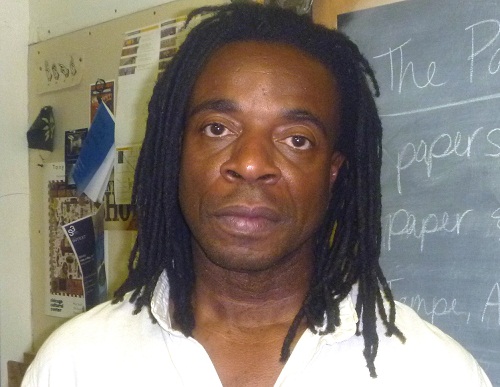
Willie Cole. BlackArtistNews photo. All rights reserved.

To assess Willie Cole’s varied artistic achievements and simply dub him a “Renaissance Man” or the “quintessential artist” is clichéd and lazy-minded. Given the volume and quality of his proficiency to express, one realizes that he’s not just merely an art maker but rather a creative force who materializes his ideas into work that comfortably rests within the firmament of art history. (Watch the YouTube clip "Willie Cole Interview" embedded at the end of this blog and witness as he transforms secondhand high heels into first-class high art.) During a recent trip to Chicago to unveil a collaborative print produced with Hummingbird Press Editions Director and Master Printer Thomas Lucas, Cole obliged BlackArtistNews “FIVE”:


What were your college years like?

Aw, man. [Laughs.] I went to college in the seventies – from 1972 to ‘76. I started in New York at the School of Visual Arts. And we were, you know, not that far from the Civil Rights movement so the black students actually separated themselves from the white students.

Even in New York?


Even in New York, yeah. So…that’s how it was socially. But in terms of my art interests, the years were good because all of my teachers were famous artists in New York at the School of Visual Arts:  I had Chuck Close for painting and Jonathan Borofsky for sculpture.  And even though I was an illustration and graphic design major I [was] able to get these successful artists early in their careers as teachers. So that was a good thing. And when I went to Boston University the racism was much worse.
When did you attend Boston University?
I went to SVA for two years and I wanted to go to a big school ‘cause my sister went to Western Michigan and was in a sorority and having parties and a lot of fun. So I wanted to have the same experience so I went to BU. And um, it was worse there; the racism was worse there at the time.
Do you ever experience anxiety when you work?
When I work?
Yeah, when you create art. And if you do, how do you deal with it?
Well, I go through an emotional rollercoaster with every work of art because each piece becomes my entire life for months at a time. It’s my twenty-four hour focus; I dream about it, I think about it all day. And currently – the past two years – I’ve been living alone so it really gets to me more and more. Sometimes I find that I have to leave a piece alone for a month or so in order to see it. I do a lot of sculpture out of shoes so it’s easy for me to see that the shoe is something other than the shoe. But that doesn’t mean the public can see it. So I have to walk away from it for a month and come back and see what it looks like to me. So lots of emotions in general all around [my] art production.
At this point in your career whose insight and feedback do you trust the most?
Hum… [Pauses.] That’s a tough one. I’m glad this is not live radio. [Laughs.]
[Laughs.]
But that’s a tough one. In my life I’ve had three people but they’ve all passed away now. So I would have to say my former wife because she’s intelligent and worldly and she knows me well.
And the friends who have passed away?
I had a friend who was an African Art dealer named Lawrence Ramsey he passed away in ‘94. He was probably my greatest inspiration and mentor in life ‘cause he was a black man and he was self-employed, he was an art dealer [specializing] in African Art, he was aware of culture and he was a great man. And he introduced me to African art in a deeper way because he allowed me to pick up an African mask and put it on my face; you can’t do [that] in a museum! Or I could blow the ivory horn and you know all that kind of stuff. And most recently a friend of mine, an artist named Tony Lordi passed away last year. And he was my biggest fan but he saw me the way the world sees me, opposed to the way that I see myself. To me I’m still, you know, “Willie from the block.” But [Tony] always saw me as a successful, famous artist. On the phone he would call me and he would say “Hello, is this the famous Willie Cole?”
[Laughs.]
So you know, he kept me pumped up. And that was valuable. [Laughs.]
For you what matters most in art: truth or sentiment?
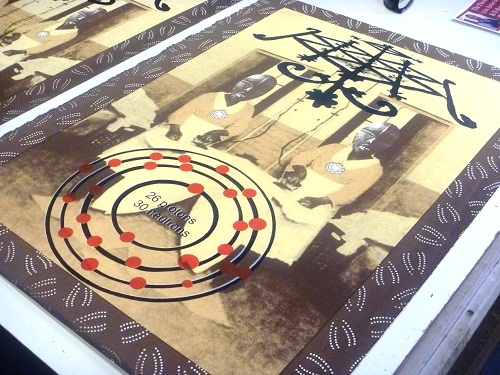
Ah, I would say truth.  But for me art is exploration. This gentleman and I were talking earlier today about art as a metaphor. It’s like in this piece here (Note: Cole is referring to the collaboration print mentioned earlier, see photo below.) people respond to it aesthetically and they won’t know what it means unless they have the knowledge of these symbols but they can still appreciate the beauty of it. So I don’t know that might be coming from truth and sentiment. [Laughs.] ’Cause the truth is there—it’s just a play on words. These are four representations of a steam iron but if you don’t know that, you’ll just see two women and chandelier and etcetera, etcetera. And you may get a sentimental feeling from that. But the truth is the real essence of the piece. So I guess I would have to say for me personally: truth. But if you put another word in there for me it would have to be transformation. I like transforming objects and making people see things differently for the rest of their lives; you’ll never see the same way again.
Does art matter?
Art does matter. Everything is art. Art is not just gallery and museum but just life in general. The visual awareness in existence is art. Somebody designed your shirt, the patterns on your shirt, the building we’re in. And art as a teaching tool – before the word “art” existed – people were being artistic by teaching the culture through object representation and through storytelling. So to me art is fundamental for life. The fact that we have something called the ‘Creation Story’ is evidence that art is valuable.
Willie Cole's collaborative print with Hummingbird Press Editions Director and Master Printer Thomas Lucas. BlackArtistNews photo. Copyright 2011 to the respective parties.


1:55 AM | 0 comments | Read More

FIVE: Ian Weaver

Written By UNDER MAINTENANCE on Tuesday, June 14, 2011 | 11:17 AM

“FIVE” is a special feature at BlackArtistNews where five questions are posed to an individual artist, curator, gallerist, collector or art lover. Why five questions? Well, there are five fingers on each hand and artists create with their hands hence one, two, three, four, FIVE.
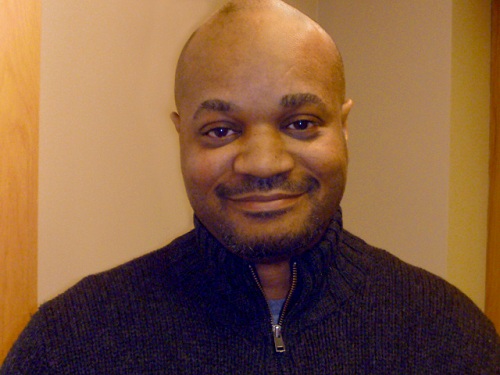
Ian Weaver. BlackArtistNews photo. All rights reserved.
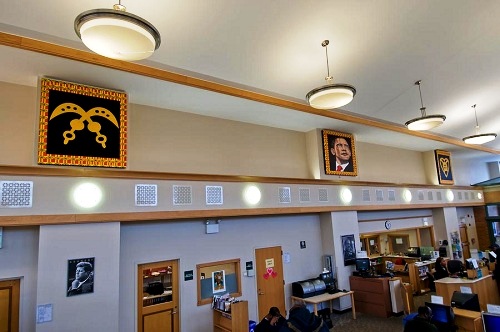
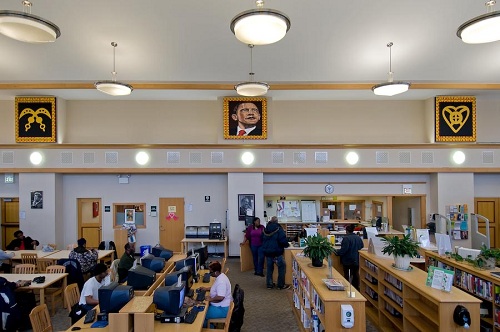
Ian Weaver is an artist gratified by his interpersonal relationships. It's safe to assume that aspects of the bonds created with family, friends, fellow artists and the communities where he gives art lessons informed (and inspired) the fictional world of his solo exhibit Ian Weaver: An Incomplete History (2004-2011) on view June 18th through September 4th at the South Bend Museum of Art. With intelligence and imagination the Chicago-based artist deftly crafted and assembled materials that -- according to the museum's overview -- "speak to the larger concept of how we, as individuals, communities and societies construct our own narratives, identities, and memories." Weaver recounted his own narratives and memories for BlackArtistNews during a reception celebrating the installation of his triptych painting "Barack Obama and the Principles of Courage and Hope" at the Chicago Public Library's West Englewood Branch where he responded to "FIVE":

What’s your connection to the Englewood community?

I was born in the area. I was born at the University of Illinois Hospital but then I grew up over at 64th and Yale so technically I’m from the area. Then I moved much further south, but I [still] have a strong connection: I’ve done workshops and things at schools in the community.

Are you aware of the fact that Richard Hunt, Charles White and Archibald Motley each lived in Englewood?

I knew about Motley. I didn’t know about Richard Hunt. Actually, I have a connection with Richard Hunt through another person – a printmaker that [Hunt is working] with right now.

Since we’re on the subject of community, what’s your support system?

Personally?  Well, right now I’m teaching. I teach at the School of the Art Institute [of Chicago] in two different departments. I’m in the painting and drawing department and then their first year program so that’s one thing, but you know adjuncts don’t make very much money.

I’m sorry, I didn’t mean financially, I meant support in terms of family or people in your corner that support and nurture your artistic expression.

That’s okay. I think all of them are important. You definitely need the financial in order to make the work but even if you have a lot of money and you don’t have the support it’s very difficult.  My family has always been a big supporter of my work – my mom in particular. I grew up with a single mom – five kids in the family total – and she [worked] two sometimes three jobs to support us. But the funny thing is when I tell my students at the Art Institute – which is a completely different demographic quite honestly – they’re shocked out of their seats. But when I go to Kennedy-King [College, one of the City Colleges of Chicago located in Englewood] and I lecture they understand that unfortunately, it’s the norm. The expectations are already there to succeed regardless of what situation you’re born into. That’s something really important for the students to realize. But in terms of my support outside [of] financial [it’s] definitely my family. Also the family of artists that I have;  A couple of those people will be coming out tonight – my friend Sadie Woods who’s a really well-known local dj with her partner Madrid. They run White Label; they do all sorts of programs and events [related to] art [and] fashion, so they’ve got their hands into many things. And I know Kerry James Marshall. He’s been a big supporter in the sense of always giving me advice [with] basic things like writing letters of recommendations [and] stuff like that.

How did you meet Kerry James Marshall?

Um, he was a part of an exhibit at the Block Museum [in Evanston, IL] back in the mid-nineties, so I’ve known him for a while. And I went out there…actually to backtrack:  A former instructor of mine at Columbia College – which is where I did my BA – came by for a studio visit. This was like in the early nineties and she said you know “if you’re starting to think about these ideas of identity you may want to look at this artist Kerry James Marshall who’s getting some press right now.” [This was] before [he received] the "genius" grant and everything else. So I took that opportunity and went there ‘cause he was in this group show there at the Block for American printmakers or I think it was Chicago-based printmakers, historically like maybe 1945 to present. So I [walked] up to him and talked to him and he was very open. He’s always been open to students; you know he taught for years at the University of Illinois at Chicago. He’s especially open – to be frank – with students of color.

Okay.

And so I’ve maintained connections with him and whenever I’ve had a show or [received a] grant he’s always emailed me and said congratulations on that. He’s really a good guy. He’s a senior figure – I mean he’s not senior, he’s not old – but for me he’s like a senior figure that I look up to. So I think all of those – the art community and my family community would be that sort of support. And then of course like I said the financial support is a totally different thing as well.

Ian Weaver. Barack Obama and the Principles of Courage and Hope (2009)
Oil, enamel and acrylic on wood panels
Center panel: 48"x 60"; Left and right panels: 60"x 48" (Courtesy of the artist.)

Do you set aside time to create art or do you work according to mood?

Nooooo, I have to be really disciplined. (Laughs) ‘Cause if I wasn’t it wouldn’t get done. To be honest, at heart I don’t have that in me. I need to really have things completely organized. Partly because I’m doing a lot of different things; [along] with the teaching and the workshops, I travel. I just recently came back from New York for a quick weekend to see some things there.

Did you see the Glenn Ligon show?

I didn’t get to that. I saw Willie Cole’s work at the Met though.

Cool.

And I’m on Facebook and I’m the one who posted about the Ligon show and somebody sent me an email when I said I was going to New York [they wrote] “don’t forget the show.” But I was there for three days. I always go to the Met and MoMA for sure. But I was kicking myself….I’ve never been to the Whitney. There are so many museums; New York is so big. I went to the Brooklyn Museum for the first time.

I like the Brooklyn Museum.

I like it. It’s a nice size. It’s a beautiful building.

I assume you saw the Lorna Simpson: Gathered exhibit that’s there now.

Yes! Yes! It was beautiful. That’s in their [Elizabeth A. Sackler Center] and I also saw [Judy Chicago’s] Dinner Party for the first time and that’s like a seminal piece for feminist art. But yeah, the Lorna Simpson stuff was really beautiful. In particular the found photos that she collected. The images are small and very haunting, really beautiful. The Brooklyn Museum’s got it going on; you walk in the lobby the first thing you see is a Kehinde Wiley image. I think it’s nice.

Does art matter?

Oh, of course! (Laughs) It matters in so many different ways. I work in the Chicago Public School system doing workshops and you know that’s generally the first program that’s cut. For me growing up, I made connections through art to geography [and] history.  I didn’t have any of that information just through my geography classes or my history classes – and I went to pretty good schools. [But] you [can] learn about all those different things through the filter of art. I think for students it’s a lot easier for them to learn through that filter. So in that sort of basic literal sense it matters. [But] that justification shouldn’t be the only reason that it matters. It matters because if you’re living in a culturally reflective society you need to have an appreciation of art.

At this point, an unidentified gentleman (who stood by quietly during the interview) raised his hand and said: “It makes us human.”

Yeah! It definitely does and I think that that’s so vital.

Installation view of Ian Weaver's Barack Obama and the Principles of Courage and Hope (2009),
West Englewood Branch Library, Chicago, IL. Photo courtesy of the artist.

Installation view of Ian Weaver's Barack Obama and the Principles of Courage and Hope (2009), 
West Englewood Branch Library, Chicago, IL. Photo courtesy of the artist.
11:17 AM | 0 comments | Read More