Recent Comments

Popular Posts

Showing posts with label Betye Saar. Show all posts

CENTER STAGE: Art Saars Betye, Lezley and Alison share work, words with Chicago audience

Written By UNDER MAINTENANCE on Wednesday, November 2, 2011 | 2:42 PM

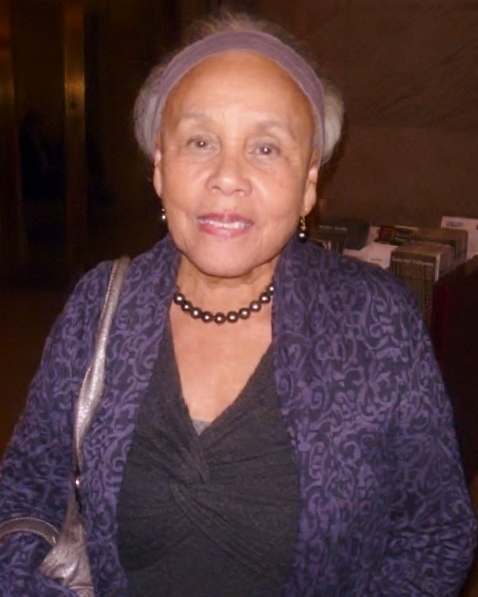
Artist Betye Saar (pictured) along with daughters Lezley and Alison discussed their work before an audience at the Art Institute of Chicago. BlackArtistNews photo. All Rights Reserved.

All-star art family gathered for intimate discussion on art
BlackArtistNews | November 2, 2011

Conversation within the all-star art family of matriarch Betye Saar and her daughters Lezley and Alison is probably a daily event.

It’s probably no big deal for them to spend time with each other in their respective homes, studios and even exhibition spaces.

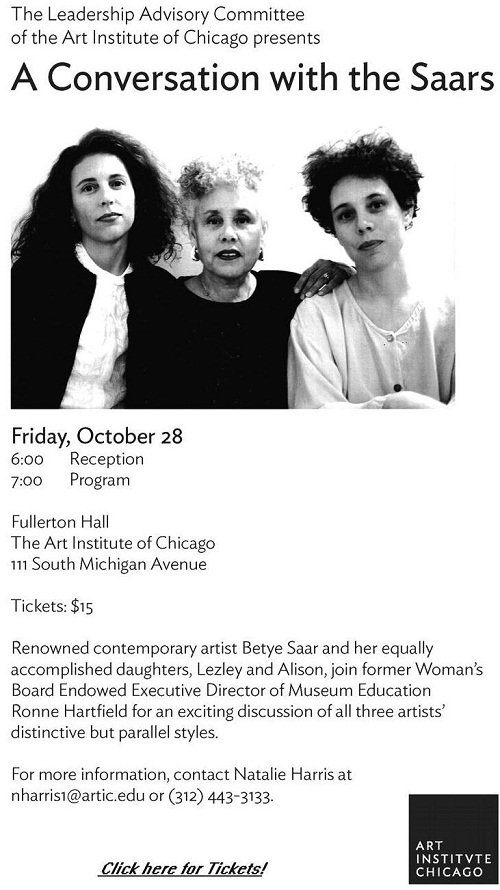
Yet, surprisingly, an event billed as “A Conversation with the Saars” (held October 28, 2011 at the Art Institute of Chicago) was the first time they’d sat side-by-side onstage for an intimate – albeit public – discussion on art.

With photographs of their art works projected onto a large screen above their heads, Betye Saar, who recently received the 2011 Lifetime Achievement Award in visual art from the California African American Museum, led the discussion followed by Alison and Lezley.

Each artist spoke candidly about the inspiration and meanings of (what they felt were) significant installation, mixed media, assemblage and sculptural works produced within the last eight years.

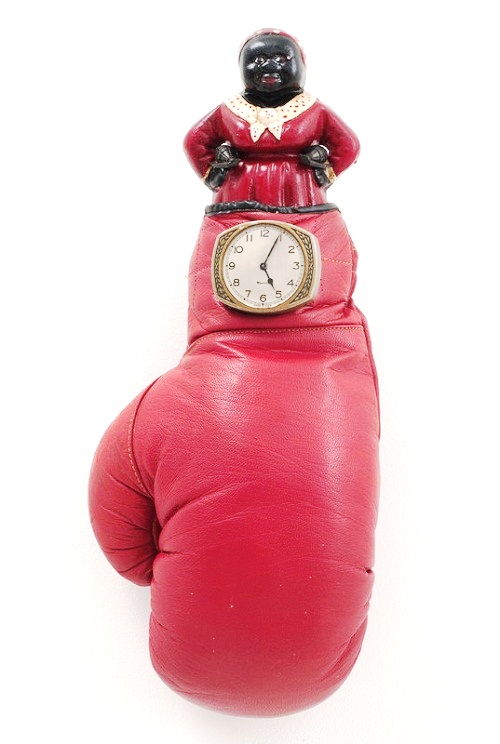
When Betye pointed out a Sambo character painted on a clock used in her current installation Red Time at Roberts & Tilton in L.A. a collective murmur permeated the audience.

Alison quickly massaged the tension.


"We're very fierce ladies," she interjected. "You see us being very demure up here, you should see us in the studio."

"I use chain saws," Lezley quipped. Everyone laughed.

The conversation was moderated by author and museum consultant Ronne Hartfield who expertly communicated how the Saars fit – individually and collectively – into the framework of American Art history.

For the audience (which included artist Kerry James Marshall, photographer Dawoud Bey and AIC curator James Rondeau) it was a historic pre-Halloween treat.

The event was sponsored and organized by AIC’s
Leadership Advisory Committee (LAC) which was founded in 1994 to “promote and sustain diversity within the institution.”

This program and an upcoming talk between Kerry James Marshall and art historian Kymberly Pinder definitely keep that mission on track.


Family Legacies: The Art of Betye, Lezley, and Alison Saar (University of Washington Press).
2:42 PM | 0 comments | Read More

EVENT: A Conversation with the Saars / Art Institute of Chicago / October 28, 2011

Written By UNDER MAINTENANCE on Wednesday, October 12, 2011 | 10:36 AM


ABOUT THE LEADERSHIP ADVISORY COMMITTEE:

In 1994, the Art Institute established a committee comprised of African American community leaders with the mission to promote and sustain diversity within the institution. At that time, the Art Institute received a grant from the Lila Wallace Reader's Digest Fund to support this initiative that continues to exist today as the Leadership Advisory Committee (LAC). 

The LAC of the Art Institute provides counsel, new perspectives, and support to the museum on all matters relating to the engagement and advancement of African Americans in the life of the institution.

The LAC believes diversity in vision, collections, exhibitions, staffing, and audience is critical to the future and well being of all American cultural institutions, and it is committed to engaging the broadest and most diverse audience in support of this vision via marketing, development, and educational programming.

Membership by invitation only

Contact Natalie Harris, associate director of Leadership Advisory Committee, at (312) 443-3133 ornharris1@artic.edu for more information about upcoming activities.


(Secure Web Link)

10:36 AM | 0 comments | Read More

LOS ANGELES: Now Dig This! Art and Black Los Angeles 1960-1980 / Hammer Museum / October 2, 2011 - January 8, 2012

Written By UNDER MAINTENANCE on Saturday, October 1, 2011 | 10:01 PM


Now Dig This! Art and Black Los Angeles 1960-1980
October 2, 2011 - January 8, 2012
10899 Wilshire Boulevard
Los Angeles, CA

Now Dig This! Art and Black Los Angeles 1960–1980 chronicles the vital legacy of the city’s African American artists. The work of these practitioners was animated to an extent by the civil rights and Black Power movements, reflecting the changing sense of what constituted African American identity and American culture. The power of the black community strengthened nationwide as racial discrimination began to lessen as a result of new legislation and changing social norms. As there were plentiful opportunities for African Americans to make a livelihood in Southern California, Los Angeles soon had a substantial black population, and social, political, and economic changes drew transplants from around the country. Galvanized by these transformations, black artists worked to form a cultural community that became an important part of the city’s thriving arts scene.Now Dig This! examines a pioneering group of African American artists whose work, connections, and friendships with other artists of varied ethnic backgrounds influenced the creative community and artistic practices that developed in Los Angeles during this historic period. The exhibition presents 140 artworks by these artists and the friends who influenced and supported them during this period and explores and celebrates the significant contributions of African Americans to the canon of Los Angeles–based art.

“The artists that have been included in
 Now Dig This! represent a vibrant group whose work is critical to a more complete and dynamic understanding of twentieth century American art. Their influence goes beyond their immediate creative circles and their legacy is something we are only now beginning to fully understand,” says exhibition curator Kellie Jones.

During the 1960s and 1970s, artists in Southern California developed an aesthetic language that reflected their West Coast surroundings and explored various approaches to art making, including assemblage, “finish fetish,” California pop, installation, and performance. Several prominent black artists began their careers in the Los Angeles area, including 
Melvin Edwards, David Hammons, Maren Hassinger, Senga Nengudi, John Outterbridge, Noah Purifoy, and Betye Saar. They were part of a unique support system that involved a confluence of artists, curators, scholars, and gallerists in Southern California. Samella Lewis, Suzanne Jackson, and Dale Brockman Davis and Alonzo Davis opened galleries that became important outlets and gathering places for black artists. Lewis, a noted art historian, also wrote books and articles that established a benchmark for the documentation and analysis of the work of contemporary African American artists.

In the fall of 1966 UCLA’s Dickson Art Center inaugurated its new building with the exhibition The Negro in American Art. Although the exhibition was national in scope, a significant portion of the artists were from Los Angeles and were part of a group working with Noah Purifoy and the Watts Towers Arts Center to reclaim the remains of the Watts uprising, which had taken place just one year earlier, by using them to make art. Seven artists in the current exhibition—Melvin Edwards, Daniel LaRue Johnson, Noah Purifoy, Betye Saar, Raymond Saunders, Ruth G. Waddy, and Charles White—were among the more than forty who participated in the 1966 show. Moreover, three of the works presented in the earlier exhibition—Edwards’s The Lifted X and August the Squared Fire, along with Johnson’s Big Red, all from 1965—are on view here. Now Dig This! expands on this legacy and considers the activities of African American artists in Los Angeles during these pivotal years through a broader lens. —Kellie Jones, Guest Curator
Now Dig This! is presented as part of Pacific Standard Time, a collaboration of more than sixty cultural institutions across Southern California, coming together for six months beginning in October 2011 to tell the story of the birth of the Los Angeles art scene and how it became a new force in the art world. Organized by the Hammer and curated by Columbia University professor Kellie Jones, Now Dig This! will chronicle and celebrate this nuanced and multicultural history of Los Angeles. 

“Pacific Standard Time is a very significant event for the city of Los Angeles. The deep and remarkable history it explores serves as a foundation for the thriving creative community of artists living and working here today,” remarks Hammer director Ann Philbin. “
Now Dig This! reveals a specific moment when a group of African American artists, gallerists, writers, and collectors generated a nexus of creativity and influence that is largely unknown to the general public.” 

NOW DIG THIS! FEATURED ARTISTS
John Altoon
Sister Karen Boccalero/Self Help Graphics
Marie Johnson Calloway
George Clack
Dan Concholar
Houston Conwill
Alonzo Davis
Dale Brockman Davis
Sheila Levrant de Bretteville
Mark di Suvero
Melvin Edwards
Fred Eversley
Charles Gaines
David Hammons
Maren Hassinger
Suzanne Jackson
Virginia Jaramillo
Ulysses Jenkins
Daniel LaRue Johnson
Elizabeth Leigh-Taylor
Samella Lewis
Ron Miyashiro
Senga Nengudi
John Outterbridge
Joe Overstreet
William Pajaud
Noah Purifoy
John T. Riddle Jr.
Betye Saar
Raymond Saunders
Ruth G. Waddy
Gordon Wagner
Charles White
Tyrus Wong
Andrew Zermeño/Mechicano Art Center

Hammer Museum Video: Curator Kellie Jones discusses Now Dig This!


About Pacific Standard Time: Art in L.A. 1945 – 1980
Pacific Standard Time is a collaboration of more than sixty cultural institutions across Southern California, coming together for six months beginning in October 2011 to tell the story of the birth of the Los Angeles art scene and how it became a major new force in the art world. Each institution will make its own contribution to this grand-scale story of artistic innovation and social change, told through a multitude of simultaneous exhibitions and programs. Exploring and celebrating the significance of the crucial post-World War II years through the tumultuous period of the 1960s and 70s, Pacific Standard Time encompasses developments from L.A. Pop to post-minimalism; from modernist architecture and design to multi-media installations; from the films of the African American L.A. Rebellion to the feminist activities of the Woman’s Building; from ceramics to Chicano performance art; and from Japanese American design to the pioneering work of artists’ collectives. Initiated through $10 million in grants from the Getty Foundation, Pacific Standard Time involves cultural institutions of every size and character across Southern California, from Greater Los Angeles to San Diego and Santa Barbara to Palm Springs.

Now Dig This! Art and Black Los Angeles 1960-1980 has been made possible by major grants from the Getty Foundation. Generous support has been provided by the Henry Luce Foundation; the National Endowment for the Arts, a federal agency; The Andy Warhol Foundation for the Visual Arts, which funded a Curatorial Research Fellowship; and The Broad Art Foundation. Additional support has been provided by the Eileen Harris Norton Foundation, The Kenneth T. and Eileen L. Norris Foundation, Ina Coleman and Alan Wilson, and V. Joy Simmons, M.D. In-kind support has been provided by InterfaceFLOR.

10:01 PM | 0 comments | Read More

CULVER CITY: Betye Saar / Red Time / Roberts & Tilton / September 10 - December 17, 2011

Written By UNDER MAINTENANCE on Saturday, September 10, 2011 | 10:45 AM

Betye Saar, Sock it to 'Em, 2011, Mixed media assemblage, 17.75 x 8 x 5 in (45.1 x 20.3 x 12.7 cm)
BETYE SAAR
RED TIME
September 10 - December 17, 2011
Roberts & Tilton
5801 Washington Blvd
Culver City, CA

Roberts & Tilton is pleased to announce, Red Time, a site-specific retrospective installation by pioneering Los Angeles artist, Betye Saar (b. 1926, Los Angeles). An amalgamation of found, created, borrowed and recycled objects, the installation will examine Saar’s past, present and future. Red Time is set to divide Saar’s practice into three categories: “In the Beginning,” “Migration and Transformation” and “Beyond Memory.” 

“In the Beginning” includes works from 1960-1970, exhibiting Saar’s interest in metaphysics, the occult and magic. These works incorporate Euro-centric concepts of palmistry, phrenology and astrology in addition to Afro-centric concepts of voodoo and shamanism. Works from this period take form in print, drawing, as well as Assemblage windows, boxes and alters. During this time, while mother to three, Saar became a respected member of Los Angeles art community with peers that include David Hammons, John Outterbridge, Ed Kienholz and George Herms. Many of the works Saar created during 1960-1970 begin to bridge the unknown and the uncomfortable, with allusions to such artists as Romare Bearden, Jacob Lawrence and Joseph Cornell.

Spanning from 1970-2010, “Migration and Transformation” focuses on works of strong social and political content. Subjects such as the Diaspora, slavery, racism, revolution and feminism are explored in varying mixed media Assemblages—boxes, washboards, trays and cages—each paradigmatic of Saar’s comprehensive body of work. Saar’s use of borderline hazardous, racially charged imagery has resulted in an extraordinarily significant body of work created in the United States’ Post-Civil Rights era. In his 2011 publication, How Racism Takes Place, George Lipsitz writes: 
“Saar also recognized… that struggles against racism could be undermined by uncritical absorption of sexist hierarchies, that Black women’s experiences gave them especially important things to say about race and space. Saar responded by changing the scale of space, by burrowing in, constructing works of art from material items, images and ideas grounded in everyday life, emphasizing connections between the physical places of the city and the discursive and political spaces that shaped Black consciousness and culture… ” 
Works from “Migration and Transformation” are combative— these works are Saar’s own forceful yet thoughtful counter attack on racism in America—past and present. The Liberation of Aunt Jemima (1972) is the exemplary, if not best known, manifestation of Saar’s enlistment and transposition of “hazardous” imagery. And while similar content and visual imagery continue to be present in her most recent work, Saar persists in pushing boundaries. “Beyond Memory,” a selection of recent work from 2010-2011, highlights Saar’s quest for a new creative expression through the reinterpretation of language, objects and materials.

Widely recognized as a seminal Los Angeles artist, Betye Saar received her BA from the University of California, Los Angeles in 1949, with graduate studies at California State University at Long Beach, the University of Southern California, and California State University at Northridge. Saar’s work is found in the permanent collections of the Los Angeles County Museum of Art, Los Angeles; the Metropolitan Museum of Art, New York; the Studio Museum of Harlem, New York; the Whitney Museum of American Art, New York; the Philadelphia Museum of Art, Philadelphia; the Smithsonian American Art Museum, Washington, DC; the Museum of Fine Art, Boston; the High Museum of Art, Atlanta; and the Walker Art Center, Minneapolis and the California African American Museum, Los Angeles. Saar has been the subject of solo exhibitions at the Museum of Contemporary Art, Los Angeles; The Studio Museum in Harlem, New York; San Francisco Museum of Modern Art, San Francisco; the Whitney Museum of American Art, New York; List Visual Arts Center at Massachusetts Institute of Technology, Cambridge; and the Santa Monica Museum of Art, Santa Monica.

Saar has been recipient of two National Endowment for the Arts Fellowships (1974, 1984), a J. Paul Getty Fund for the Visual Arts Fellowship (1990), and a Flintridge Foundation Visual Artists Award (1998). In 1994, she and artist John Outterbridge represented the United States at the 22nd São Paulo Biennial in Brazil. 

Betye Saar will be featured in seven Pacific Standard Time exhibitions: Now Dig This! at the Hammer Museum, Under the Big Black Sun at the Museum of Contemporary Art Los Angeles, Cross Currents in L.A. Painting and Sculpture, 1950-1970 at the Getty Museum, Civic Virtue: The Impact of the Los Angeles Municipal Art Gallery and the Watts Towers Art Center at the Los Angeles Municipal Art Gallery and the Watts Towers Art Center, Artistic Evolution: California Artists at Natural History Museum, 1945-1963 at the Natural History Museum, L.A. Raw: Abject Expressionism in Los Angeles, 1945-1980: From Rico Lebrun to Paul McCarthy at Pasadena Museum for California Art and Place of Validation: Art and Progression California African American Museum. Red Time will be Betye Saar’s first solo gallery show in Los Angeles since 1998 and her first show at Roberts & Tilton. Special thanks to Michael Rosenfeld Gallery.

Gallery hours are Tuesday – Saturday, 11:00am – 6:00pm.
For additional information, please contact 
Lauren Kabakoff at lauren@robertsandtilton.com or 323.549.0223.

Roberts & Tilton is a Participating Gallery of Pacific Standard Time. This unprecedented collaboration, initiated by the Getty, brings together more than sixty cultural institutions from across Southern California for six months beginning October 2011 to tell the story of the birth of the L.A. art scene. For further details, please visit pacificstandardtime.org

10:45 AM | 0 comments | Read More