Recent Comments

Popular Posts

Showing posts with label Exhibit. Show all posts

CLARKSTON: Bello AG / Georgia Perimeter College

Written By UNDER MAINTENANCE on Monday, January 9, 2012 | 9:14 AM

Hunter vs. Prey by Bello AG. Courtesy of the artist.

Abstramentia: New Drawings and Paintings by Bello AG
January 9 - March 2, 2012
Opening reception: January 25, 2012

GEORGIA PERIMETER COLLEGE STUDIO GALLERY
Department of Fine Arts 
555 North Indian Creek Drive
Clarkston, GA 

Bello AG is a self-taught artist and photographer based in Atlanta, Georgia.

Abstramentia is his second solo show.

Admission to the exhibit is free to the general public.

For additional information about Abstramentia contact the Georgia Perimeter College Studio Gallery at 678-891-3556.
  
Fur by Bello AG. Courtesy of the artist.

Address media inquiries for Bello AG to arkanegalleryart@gmail.com

9:14 AM | 0 comments | Read More

CAPTURED: My Year in Art 2011

Written By UNDER MAINTENANCE on Tuesday, December 27, 2011 | 12:16 AM


Detail of mural by Franco the Great
West 125th Street, Harlem, NY
February 11, 2011

The Global Africa Project
Museum of Art and Design, NY
February 12, 2011
Stargazers: Elizabeth Catlett in Conversation with 21 Contemporary Artists
The Bronx Museum of the Arts
February 13, 2011

Glenn Ligon: America
The Whitney Museum, New York
June 2, 2011

Dust Jackets for the Niggerati -- and Supporting Dissertations, 
Drawings submitted ruefully by Dr. Kara E. Walker 
Sikkema Jenkins & Company, New York
June 2, 2011

Nathaniel Donnett, Messin' With Texas
Hyde Park Art Center, Chicago, IL
June 12, 2011
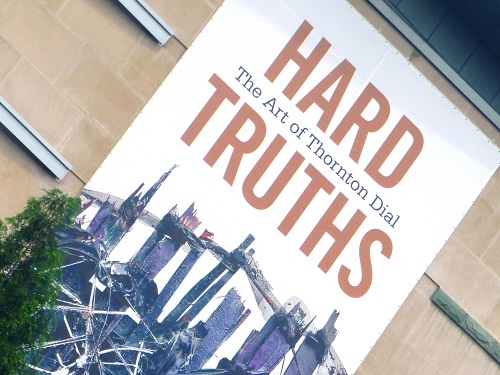
Hard Truths: The Art of Thornton Dial
Indianapolis Museum of Art 
August 20, 2011

Kerry James Marshall
We Have Voice, We Have Temper -- African American Artists and Public Discourse 
Art Institute of Chicago 
November 17, 2011

David Hartt: Stray Light
Museum of Contemporary Art Chicago 
December 3, 2011


All photos © 2011 BlackArtistNews. All rights reserved.


12:16 AM | 0 comments | Read More

BROOKYLN: The New York Group Show (Curated Exhibition)

Written By UNDER MAINTENANCE on Sunday, December 25, 2011 | 11:42 PM


The New York Group Show
December 28, 2011 - January 1, 2011

Kianga Ellis Projects is pleased to host a special exhibition for the holidays. 48 artists who answered the art call will present work in all media for THE NEW YORK GROUP SHOW:


"I am the judge. I am the jury."
Rebellion & Empowerment in Contemporary Art 

An opening reception for the artists will take place on Wednesday, December 28th from 6:00 - 8:00 pm at 41 Kosciusko Street in Brooklyn. 

Map & Directions: http://g.co/maps/52bwm

The show will be on view until 6:00 pm Sunday, Jan 1st by appointment.

RSVP Required.


11:42 PM | 0 comments | Read More

POST: Julien Hudson / The Milford Daily News

Written By UNDER MAINTENANCE on Tuesday, December 13, 2011 | 6:33 AM

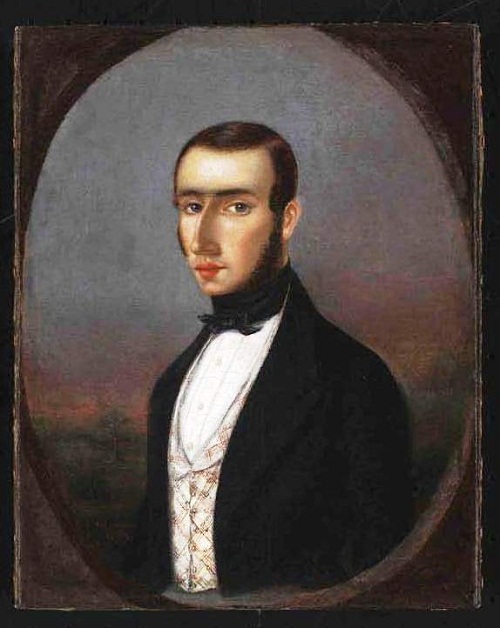
Julien Hudson, Portrait of a Man, Called A Self-portrait, 1839. Oil on canvas. Collection of Louisiana State Museum.
An art history mystery at Worcester Art Museum

Text: Chris Bergeron for Metro West Daily News
Published: December 12, 2011

WORCHESTER -- Forget the da Vinci Code.    There’s no Knight Templars or murderous albinos, but the life and death of Julien Hudson and the whereabouts of his paintings is a fascinating “art historical mystery’’ waiting to be solved.

The second-earliest documented painter of African descent in the U.S., Hudson was making his mark as a portraitist in New Orleans in the early 1800s before dying of unknown causes, leaving behind just six canvases.

Who was the man with searching eyes in one of his remaining paintings? Did he kill himself, as some suspect? With his sixth painting discovered by a New England collector, can more of Hudson’s valuable works be found in area shops, flea markets or your attic?

An intriguing exhibit, “In Search of Julien Hudson,’’ at the Worcester Art Museum, offers the first retrospective about the man and the artist whose enigmatic career casts light on the lives of free blacks and mixed race people in Louisiana before the Civil War?

Organizer William Keyse Rudolph said, “The search for Julien Hudson isn’t over.’’

“Julien was a very charming painter. He’s definitely important from the historical and biographical standpoint. And he’s definitely part of the bigger story of art in New Orleans on a grand scale,’’ he said.

The former curator of American Art at WAM, Rudolph worked with staff at The Historic New Orleans Collection to include all of Hudson’s known paintings, work by his teachers, contemporaries and student.

Rudolph recently took over as curator of American art and decorative art at the Milwaukee Art Museum.

Subtitled “Free Artist of Color in Pre-Civil War New Orleans,’’ the exhibit, which is making its third and final stop in Worcester, will be on view through March 11.

While comprising about 35 paintings, sculptures, photos and documents, the exhibit opens a revealing window on the little-known communities of free people of color, or “gens de couleur libre,’’ that thrived in New Orleans, Baltimore and Charleston, S.C., between the Revolution and Civil War.

Rudolph said, “For the very first time we’re using Hudson’s life and art to tell a bigger story about free people of color. … It’s fascinating story that a lot of people in the North don’t know.’’

Filling three galleries, the exhibit starts by examining Hudson’s origins, training and striking examples of portraits by other black artists. A small enclosed middle section showcases all the artist’s works and the third section includes work by his contemporaries.

Visitors will see all six of Hudson’s known paintings, distinctive portraits that display the conventions of the era while displaying the stylistic influence of the artist’s two trips to Paris.

In two early paintings of children, “Portrait of a Young Girl With A Rose’’ and “Portrait of a Boy with a Moth’’ from 1834 and 1835, Hudson conventionally put symbolic objects in the children’s hands and places them against colorful backgrounds.
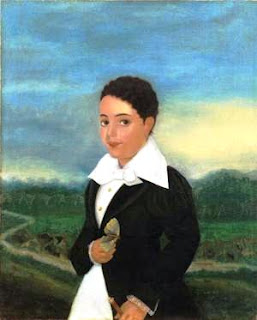
Julien Hudson, Creole Boy With A Moth, 1835. Oil on canvas. Private  collection.

Four years later, after returning from France, Hudson depicted Jean Michel Fortier — the only portrait in which the sitter is known — as direct and forceful and a bit of a dandy.

Equally fascinating, the show features paintings by other black and mixed-race artists whose portraits often depict people of their community in a surprising new light.

There are several distinctive sculptures by Florville Foy, a free black who was a successful artist, marble cutter and business owner.

For many New Englanders, “In Search of Julien Hudson’’ will provide an exciting opportunity to learn about a vital subculture of the pre-Civil War South that belies some stereotypes and confirms others.

Rudolph explained that Hudson was the mixed-race grandson of a woman who been freed from slavery and the oldest of four children born from the union of Desiree Marcos and Thomas Hudson, an English merchant and ship’s chandler.

From its founding in 1718 to its sale in 1803 to the U.S. as part of the Louisiana Purchase, New Orleans maintained a class of free people of color who were re garded as a “third caste,’’ with a legal and social status that positioned them between the enslaved and free whites.

Hudson’s life reveals many of the possibilities and limitations experienced by free blacks in New Orleans.

Born in 1811, he was initially apprenticed as a teenager to a tailor but after two years abandoned that career to learn to paint the then-fashionable miniature portraits from Italian Antonio Meucci. He later studied under two Europeans with close ties to Paris.

While Rudolph and other art historians have discovered fascinating details of Hudson’s life, the circumstances of his death in 1844 and the whereabouts of whatever paintings he completed during his last decade remain out of reach.

A statement by historian Rodolph Desdunes, who wrote of Creole life in the South, suggested Hudson “preferred to die in misery and anonymity rather than display his talent to the detriment of his self-respect. … It is said that disillusionment cast a cloud of despair over his whole life.’’

Yet Rudolph said no official record lists Hudson’s death in December 1844 or his burial.

Visitors will likely be drawn to Hudson’s masterpiece, an 1839 oil painting of a slim man with sideburns and deep-set eyes sometimes called “Portrait of a Man, Called a Self Portrait.’’ While some claimed it was Hudson, Rudolph said most historians today dispute that claim.

Yet 170 years later, Hudson’s subject —whatever his identity — gazes across the ages reminding us of an artist who remains tantalizingly familiar but forever unknown.


IN SEARCH OF JULIEN HUDSON: FREE ARTIST OF COLOR IN PRE-CIVIL WAR NEW ORLEANS
DECEMBER 9, 2011 - MARCH 11, 2012

55 Salisbury Street
Worcester, MA


6:33 AM | 0 comments | Read More

LOS ANGELES: Places of Validation, Art & Progression (Curated Exhibition)

Written By UNDER MAINTENANCE on Saturday, December 3, 2011 | 8:35 AM

Photo courtesy of Gene Ogami.
Places of Validation, Art & Progression
September 29, 2011 - April  1, 2012

600 State Drive - Exposition Park
Los Angeles, CA

Places of Validation, Art & Progression is an exhibit that contains artwork along with photographs from personal albums and institutional collections which document the places, events, and personal relationships of artists and their supporters between the years 1945 and 1980.  Hundreds of Black artists creatively prospered during this time period in Los Angeles, many of whom received acceptance and “self-validation” in places such as Golden State Mutual Life Insurance, Studio Watts Workshop, Watts Tower Art Center, Watts Summer Festival, Brockman Gallery, Gallery 32, Pearl C. Woods Gallery, St. Elmo's Village, The Museum of African American Art, and many others. Places of Validation, Art & Progression retraces the steps taken to build a solid foundation for Black artists to thrive upon in Los Angeles. This exhibit is free and open to the public.

8:35 AM | 0 comments | Read More

CHICAGO: David Hartt / MCA Chicago

Written By UNDER MAINTENANCE on Friday, November 25, 2011 | 7:25 AM

David Hartt, Archive, 2011. Edition of 6 + 1 AP. Courtesy of the artist and Corbett vs. Dempsey, Chicago via mcachicago.org
MCA Screen: David Hartt
November 26, 2011 - April 29, 2012

MUSEUM OF CONTEMPORARY ART CHICAGO
220 East Chicago Avenue
Chicago, IL

Chicago-based Canadian artist David Hartt’s latest work, Stray Light, inaugurates the MCA Screen, a new series of media-based exhibitions at the Museum of Contemporary Art (MCA) Chicago. Hartt’s films capture the social, cultural, political, and economic complexities of his subjects, which he then renders with a cool, dispassionate eye. His latest subject is the former Johnson Publishing Company building on South Michigan Avenue in Chicago, famous for producing Jet and Ebony magazines and as a leader in African-American taste and culture. Stray Light includes a film displayed in a gallery with a carpet designed to evoke the Johnson Publishing Company, as well as a group of photographs in an adjacent gallery. MCA Screen: David Hartt is curated by James W. Alsdorf Chief Curator Michael Darling and runs from November 26, 2011 to April 29, 2012.

Hartt records the time-capsule nature of the Johnson Publishing Company space, with its original 1971 interior design by Arthur Elrod. John Moutoussamy, an African-American partner in the firm Dubin, Dubin, Black & Moutoussamy, designed the 11-story building as the headquarters of the Johnson Publishing Company, with an iconic presence on Michigan Avenue with its illuminated Ebony-Jet marquee at the top. The interior of the building is modern, colorful, and complex, an expression of founder John Johnson’s vision of what a leading, black-owned business could be. 

The title of the project, Stray Light, is a term used to refer to unpredictable light within a controlled environment. It is also a fitting metaphor for Hartt as an outside observer of a company that has influenced so much of African-American cultural history. His film and photographs provide an intimate portrait of the dreams and ideals of the Johnson family’s business which continue under the leadership of the founder’s daughter, Linda Johnson Rice. Stray Light is, in fact, the final means to capture the essence of the building, after the unexpected news that the building was sold in late 2010 and the company has relocated to another site. Thus, Hartt’s film is a lasting document of the style and ethos of this unique work environment. 

The soundtrack for the 12-minute Stray Light film is created by Chicago composer and flutist Nicole Mitchell. Mitchell is co-president of Chicago's Association for the Advancement of Creative Musicians (AACM), an organization that, like the Johnson Publishing Company building, was created in the 1970s and has become a leader in the cultural community. 

This program is made possible by the generous contributors to the Allen M. Turner Tribute Fund, honoring his past leadership as Chairman of the MCA Board of Trustees, and by Emerge, a donor affinity group that supports the education, exhibition, and acquisition programs of the MCA. 

Support for this exhibition is generously provided by the Chauncey and Marion Deering McCormick Family Foundation. Air transportation is provided by American Airlines, the Official Airline of the Museum of Contemporary Art. The Museum of Contemporary Art, Chicago (MCA) is a nonprofit, tax-exempt organization accredited by the American Association of Museums. The MCA is generously supported by its Board of Trustees; individual and corporate members; private and corporate foundations; and government 
agencies including the Illinois Arts Council, a state agency, and the City of Chicago Department of Cultural Affairs and Special Events. Museum capital improvements are supported by a Public Museum Capital Grant from the Illinois Department of Natural Resources. The Chicago Park District generously supports MCA programs. Air transportation is provided by American Airlines, the Official Airline of the Museum of Contemporary Art.


7:25 AM | 0 comments | Read More

MEDIA NEWS: Frist Center Receives NEA Grant to Support Carrie Mae Weems

Written By UNDER MAINTENANCE on Wednesday, November 23, 2011 | 6:30 AM

Carrie Mae Weems photo by Jeff Hoone via Nasher.Duke.edu

“My responsibility as an artist is to work, to sing for my supper, to make art, beautiful and powerful, that adds and reveals; to beautify the mess of a messy world, to heal the sick and feed the helpless; to shout bravely from the rooftops and storm barricaded doors and voice the specificity of our historical moment.” 

—Carrie Mae Weems


The Frist Center for the Visual Arts will receive $48,000 from the National Endowment for the Arts in support of Carrie Mae Weems: Three Decades of Photography and Video, opening Sept. 21, 2012, as well as production of the exhibition’s accompanying catalog. The Frist Center’s grant is one of 863 NEA grants totaling $22.543 million encompassing 15 artistic disciplines and fields. The grants support projects in 47 states, the District of Columbia and Puerto Rico.

Carrie Mae Weems is a socially motivated artist whose works invite contemplation on issues surrounding race, gender and class. Increasingly, she has broadened her view to include global struggles for equality and justice. This retrospective, which is composed of more than 150 objects—primarily photographs but also written texts, audio recordings, fabric banners and videos—will provide an opportunity to trace the evolution of Weems’s career over the last 30 years. Although she employs a variety of means and addresses an array of issues, an overarching commitment to better understanding the present by closely examining history and identity is found throughout her work. A notion of universality is also present: while African-Americans are typically her primary subjects, Weems wants “people of color to stand for the human multitudes” and for her art to resonate with audiences of all races.

This exhibition is organized by the Frist Center and curated by Frist Center Curator Katie Delmez. 

The exhibition will travel to the Portland (Oregon) Museum of Art: Feb–May 2013; to the Cleveland Museum of Art: June 30–Sept. 15, 2013; and to the Guggenheim Museum Oct. 18, 2013–Jan 19, 2014.

An illustrated exhibition catalogue will be published in conjunction with the show by Yale University Press with scholarly essays by Dr. Henry Louis Gates, Jr., Professor and Director, W. E. B. Du Bois Institute for African and African American Research, Harvard University; Franklin Sirmans, Curator of Contemporary Art, the Los Angeles County Museum of Art; Dr. Deborah Willis, Professor of Photography and Imaging, New York University; and Katie Delmez, Curator, Frist Center for the Visual Arts.

“Art Works is the guiding principle at the NEA,” said agency Chairman Rocco Landesman. “And I’m pleased to see that principle represented through the 823 Art Works-funded projects included in this announcement. These projects demonstrate the imaginative and innovative capacities of artists and arts organizations to enhance the quality of life in their communities.”

“We are tremendously grateful and pleased to receive this support from the National Endowment for the Arts,” said Frist Center Executive Director Susan H. Edwards, Ph.D. “The arts both reflect and chronicle the human condition, and now, more than ever before, support for the arts in all forms is critically important. We are appreciative that the NEA is at the forefront of advocacy and support for the arts.”

In March 2011, the NEA received 1,686 eligible applications for Art Works requesting more than $84 million in funding. The resulting funding rate of 49 percent of eligible applications reflects both the significant demand for support and the ongoing vitality of the not-for-profit arts community despite current financial challenges. Art Works grants are awarded based on the applications received by the NEA and how those applications are assessed by the review panels.

A complete listing of projects recommended for Art Works grant support is available on the NEA website at arts.gov.

The Frist Center for the Visual Arts is supported in part by the Metro Nashville Arts Commission and the Tennessee Arts Commission.

About the Frist Center
Accredited by the American Association of Museums, the Frist Center for the Visual Arts, located at 919 Broadway in downtown Nashville, Tenn., is an art exhibition center dedicated to presenting the finest visual art from local, regional, U.S. and international sources in a program of changing exhibitions. The Frist Center’s Martin ArtQuest Gallery features interactive stations relating to Frist Center exhibitions. Gallery admission to the Frist Center is free for visitors 18 and younger and to Frist Center members. Additional information is available by calling (615) 244-3340 or by visiting our website at www.fristcenter.org.


 Carrie Mae Weems. A Broad and Expansive Sky-Ancient Rome, 2006. From the Roaming series. Digital c-print , 73 x 61 in.
Courtesy of the artist and Jack Shainman Gallery via fristcenter.org

Carrie Mae Weems: Three Decades of Photography and Video


EXHIBITION SCHEDULE

Frist Center for the Visual Arts: September 2012–January 2013 
Portland Art Museum: February–May 2013 
Cleveland Museum of Art: June–September 2013 
Guggenheim Museum: September 2013–January 2014


6:30 AM | 0 comments | Read More

POST: Clifford Owens / ARTINFO / November 21, 2011

Written By UNDER MAINTENANCE on Tuesday, November 22, 2011 | 8:11 AM

Clifford Owens photographed by Lizzie Gorfaine (via artinfo.com)

27 Questions for Artist Clifford Owens


Name: Clifford Owens
Age: 40
Occupation: Artist
City/Neighborhood: New York City/Elmhurst, Queens
What project are you working on now?
"Clifford Owens: Anthology."
For your "Anthology" project, you asked a multigenerational group of African-American artists to submit a performance score — written or drawn instructions for actions — and then performed them yourself throughout MoMA PS1. Twenty-six artists, including Glenn Ligon, Senga Nengudi, and Kara Walker, contributed scores. Whose contribution surprised you the most?
I was surprised by all the scores contributed to "Anthology."
You have said that you dislike the label “performance artist." Why?
I dislike labels in general, but I'm particularly allergic to the "performance artist "label that has been attached to my practice. I'm a trans-disciplinary visual artist working through photography, video, and installation. I don't want any one to confuse my practice as a visual artist with the performing arts. I'm not an actor, a dancer, or an entertainer.
All the performances you executed were based on pre-set instructions. This echoes a long legacy of performance art stretching back to Fluxus, in which the artist acts like a machine, dispassionately carrying out an a priori set of directions. Do you think this squanders spontaneity? Is that necessarily a bad thing?
First of all, "Anthology" has nothing to do with Fluxus. According to George Maciunas, the self-appointed founding leader of Fluxus, "Fluxus is about jokes." "Anthology" is not about jokes and the artists who've contributed scores are not jokers; they are serious artists. Secondly, I've interpreted the "Anthology" scores in terms of my own conceptual interests and aesthetics sensibilities. Above all, "Anthology" is intense, passionate, and remarkably spontaneous.
You carried out these performances in spaces all over MoMA PS1, from the boiler room to the attic. Which location was least conducive to the performance you did there? 
There are no locations in MoMA PS1 that could not accommodate a work of performance art. Performance art can exist in any architecture, in any space created for human interaction.
If you did all the performances over the summer, what can we expect to see now at your PS1 exhibition?
The exhibition at MoMA PS1 is comprised of photographs, videos, sound works, and live performances. Of course, the experience of the exhibition will be vastly different from the experience of being present for the performances.
What's the last show that you saw?
Lauren Kelley, "FrouFrou Conclusions," at The Kitchen. Lauren is one of the most interesting artists of her generation and this exhibition reinforces that fact.
What's the last show that surprised you?
I haven't seen that show yet.
What's your favorite place to see art?
MoMA PS1, of course.
Do you make a living off your art?
No. I do not make a living off my art; I make a life off my art.
What's the most indispensable item in your studio?
I don't have a studio. I work in my head and from my heart.
Where are you finding ideas for your work these days?
I find ideas for my work in the lives of my beautiful, brilliant sons Inti and Joaquin.
Do you collect anything?
No.
What's the last artwork you purchased?
I've never purchased a work of art.
What's the first artwork you ever sold?
The first artworks I sold are in the Studio Museum in Harlem collection.
What's the weirdest thing you ever saw happen in a museum or gallery?
Does anything weird ever happen in a museum or gallery?
What's your art-world pet peeve?
I'm not interested in the art world because the art world is not interesting. The art world is not about art; it's about class privilege.
What's your favorite post-gallery watering hole or restaurant?
When I was in residence at MoMA PS1, I frequented the Shannon Pot. I love cheap, shitty bars.
Do you have a gallery/museum-going routine?
No.
Know any good jokes?
I know a few bad jokes, but who wants to read a bad joke?
What's the last great book you read?
Emile Zola, “Germinal.”
What work of art do you wish you owned?
I would like to own one of David Hammons's handsome hats.
What would you do to get it?
I would do everything and nothing to get it. Hammons would gift one of his handsome hats to me.
What international art destination do you most want to visit?
I hate to travel.
What under-appreciated artist, gallery, or work do you think people should know about?
Terry Adkins is a brilliant artist and mentor to many, including myself.
Who's your favorite living artist?
My favorite living artist was born an hour ago.
What are your hobbies?
I don't have any hobbies. Hobbies are for boring people. 

Clifford Owens. Anthology (Nsenga Knight) (detail). 2011. Performance still. Courtesy On Stellar Rays (via momaps1.org)
Clifford Owens: Anthology
November 13, 2011 - March 12, 2012
22-25 Jackson Avenue
Long Island City, NY
8:11 AM | 0 comments | Read More

NEW YORK: Dirty Sensibilities (Curated Exhibition)

Written By UNDER MAINTENANCE on Thursday, November 17, 2011 | 10:42 PM

Tatyana Fazlalizadeh, Standing From What Was, oil and paper on canvas, 2009.

Dirty Sensibilities: A 21st Century Exploration of the New American Black South
October 14 - December 16, 2011

THE CARIBBEAN CULTURAL CENTER AFRICAN DIASPORA INSTITUTE
408 West 58th Street
New York, NY 

This unprecedented, multi-media exhibition presents work by a group of intergenerational Southern artists of African descent that have examined contemporaneous realities of life in the South from a cultural, political, cosmological and sociological perspective.

America’s southern states are often viewed monolithically, through a narrow and stereotypical lens of a romanticized antebellum past, post Civil War unrest, and 20th Century Civil Rights politics. Dirty Sensibilities explores current issues such as race relations in the Age of Obama, the survival of Southern folk traditions, post-Civil Rights realities, the significance of relationships with elders and the creation of a new Southern aesthetic.

“Much of what is known about the Black experience in the South focuses on a historical period often directly related to the oppression of enslaved Africans, their struggle for liberation and their struggles for Civil Rights after the brief period of progress experienced during Reconstruction. However, the Southern narrative includes a history rich in culture, spirituality and Africanisms that have thrived over the past four hundred plus years,” states the exhibition’s curator Shantrelle P. Lewis. “This exhibition seeks to explore those idiosyncrasies that are unique to the region of the United States situated below the Mason Dixon Line.”

Dirty Sensibilities includes work by:
10:42 PM | 0 comments | Read More