
Article by Isoul H. Harris
The December/January 2012 issue of Uptown magazine is on newsstands now.

5:56 PM | 0
comments | Read More


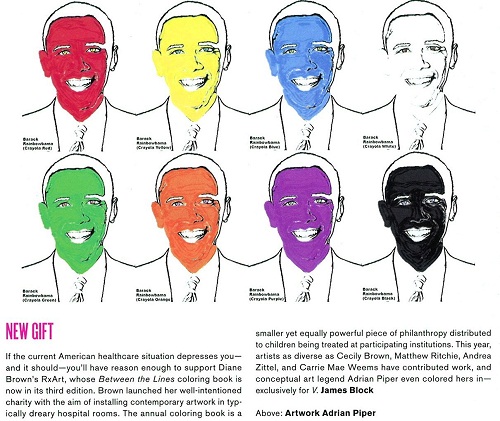
If you think coloring books are a low brow form of art strictly for kids, think again. RxArt's third annual Between the Lines coloring book (which includes contributions by Nick Cave, Trenton Hancock Doyle, David Hammons, Wangechi Mutu, Adrian Piper, and Carrie Mae Weems) will leave you in a quandary as to whether or not you should pull out a box of crayons.


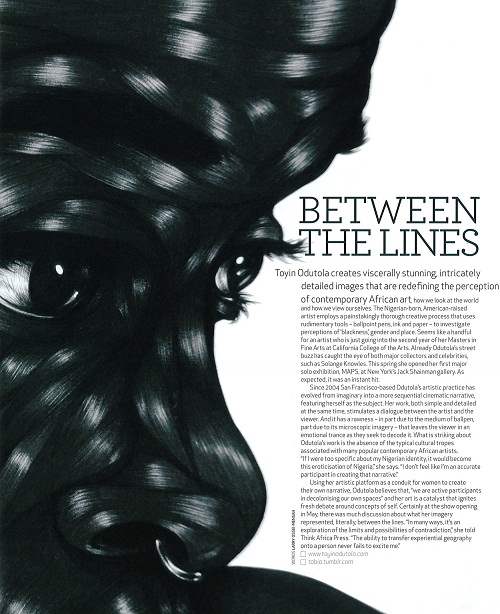

ARISE magazine is the herald of modern Africa and its global cultural echo. It aims to redress the imbalance in the portrayal of Africa, by much of the international media, by communicating the landmark successes that Africans, and people of African descent, have achieved in fields as varied as fashion, business and politics.


 |
| Clipped from the August 2011 issue of Ebony magazine. |
One bracelet. No earrings. Hair pulled back. Virtually no makeup. Refined jacket. Flat shoes. Clear desk. One large green leaf in a vase. A treetop view. No blinds.Cultural “It” girl Naomi Beckwith, the newest curator at Chicago’s Museum of Contemporary Art (MCA), is a study in minimalism. She seems to reserve all the flash and chutzpah for her heady installations, the most recent of which were stationed at the Studio Museum in Harlem. In a profession full of grand egos and lofty concepts, Beckwith’s self-assured-yet-grounded analysis of who’s got next in the world of art is refreshing. She’s from Chicago, moved to London, worked in New York City and finally has returned home. She’s got a lot to share. Listen up.EBONY: Your installations seem to be about exposing the world to artists who happen to be Black, versus exposing the world to Black artists.BECKWITH: Yes and no. There’s no difference between a Black artist and an artist who happens to be Black. I think there is a difference between Black art and art that’s made by a Black person. When you start to make all sorts of presumptions about what the artwork is, based on the fact that the person is Black, I think that’s where you start running into trouble. There’s plenty of art being made about one’s cultural background, whether that be Black or not. But there’s also plenty of art that should be seen, I think, through all sorts of other prisms outside of that sense of biography and culture.EBONY: Why is it important, then, to collect a variety of art?BECKWITH: We all leave this world at some point. Civilizations even go. The structures of the worlds go, but the only things that we really look at in the end are those archeological records—the cultural artifacts. A couple millennia from now, people are going to be interested in the jewelry that people had, and [asking] how we decorated our houses.EBONY: Will collecting this stuff, then, make us rich?BECKWITH: It’s not just about building up literal income, it’s also about acquiring cultural capital, which I think is one of the most important things to have in the world—not that I’m going to disparage money in any sort of way. But the question is, what do you do with that money?


Clipped from the August 2011 issue of Chicago magazine which named Ray Noland "Chicago's Best Street Artist."


As a light-skinned African American growing up in a predominantly dark-skinned neighborhood, Johnson was electrified when he learned about the early exploits of Walter White, executive secretary of the NAACP, 1931–55. In 1919, White used his own pale skin to pass for a white and investigate lynchings in the deep South. Inspired by White’s experiences, Johnson tells the similar story of Harlem journalist Zane Pinchback, whose own eyewitness reports of lynchings are regularly written up in a New York periodical under the byline Incognegro. Pinchback is on the verge of abandoning his undercover work for an editor’s job when he discovers his own brother is in jail and days away from lynching for apparently murdering a white woman. How Pinchback tracks down the real killer, saves his brother’s life, and narrowly escapes an angry mob form the plot of a riveting meditation on racism and self-reliance. The beautiful chiaroscuro pen-and-ink illustrations provided by veteran artist Pleece bring to vivid life one of the darkest chapters in America’s racial history. --Carl Hays

This advertisement which featured artist Sanford Biggers was clipped from an old issue of Vibe magazine. The blue scrawling on the right is actually the artist's signature and was not a part of the original ad layout.


